
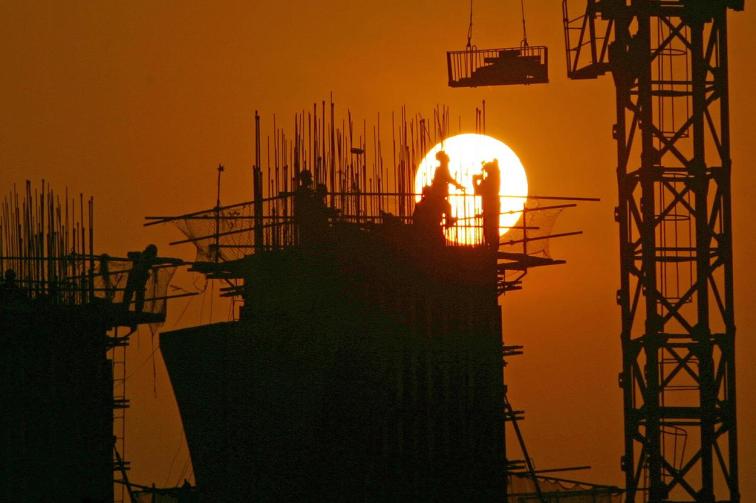
Illustration: China's economy continues to decline. (Photo by China Photos/Getty Images)
[People News] On June 3, CCTV's "News Broadcast" made a rare move by dedicating 110 seconds of prime time to promote a "bright outlook" for A-shares and the Chinese economy. However, the following day, the market responded with a significant downturn, as over 4,100 individual stocks fell. While state media persistently attempts to portray the economy as "stable with progress" and focused on "high-quality development," the market is witnessing a "collective exodus," highlighting a stark contrast between the two narratives. The reality is that many have been misled too often; it is now widely recognised that the "News Broadcast" functions as a rumour mill, and adopting a "reverse operation" strategy is advisable.
Is the "News Broadcast" turning into a whistleblower?
On the evening of June 3, CCTV's "News Broadcast" aired a report titled "Long-term Foreign Capital Optimistic About China, Continuing to Increase Investment in Hard Technology," which lasted approximately 1 minute and 49 seconds. This marks the first appearance of A-shares on the "News Broadcast" this year, with more than a year since their last feature.
The report noted that several international financial institutions have recently issued positive forecasts for the Chinese economy, increasing their investment in Chinese technology companies and accelerating their investment strategies in China.
However, the next day (June 4), all three major A-share indices experienced declines, with over 4,100 individual stocks falling across the market. The Hong Kong Hang Seng Index also dropped nearly 1.5% on the same day, creating a clear contrast between market performance and the narrative presented by state media.
At the close, the Shanghai Composite Index fell 0.64%, ending at 4,057.78 points; the Shenzhen Component Index decreased by 0.27%, closing at 15,561.57 points; and the ChiNext Index dropped 0.83%, finishing at 4,088.88 points.
Wind statistics indicate that there are 4,120 declining stocks across the two markets and the Beijing Stock Exchange.
The trading volume in the Shanghai and Shenzhen markets reached 2.75 trillion yuan, down 372.6 billion yuan from the previous trading day. Specifically, the Shanghai market recorded a trading volume of 1.2747 trillion yuan, which is a decrease of 155.1 billion yuan compared to the last trading day.
The weakness in A-shares is now affecting Hong Kong stocks, with the Hang Seng Index experiencing a significant drop on June 4, reflecting continued low market sentiment.
The Hong Kong Hang Seng Index fell by 379.81 points, or 1.48%, closing at 25,253.4 points. The total trading volume on the main board for the day was 270.23 billion Hong Kong dollars.
The State-Owned Enterprises Index decreased by 94.68 points, closing at 8,501.91 points, a decline of 1.1%. Meanwhile, the Hang Seng Technology Index dropped by 81.61 points, closing at 4,975.36 points, a decline of 1.61%.
The "News Broadcast" has issued a "flee order."
Chinese netizens have humorously reacted to this, as they have clearly recognised the Chinese Communist Party's (CCP) tendency for deception. They understand that the CCP's lies should be interpreted in reverse, and they are doing just that.
1. Retail Investors' "High-Level Black Humour": A New Type of Contrarian Investment Indicator
On Chinese social media platforms (such as Xiaohongshu, Xueqiu, and Weibo), due to strict censorship against direct criticism of economic policies, stock investors and netizens have developed a highly humorous form of "black humour."
Netizens comment: "Buy in reverse of the News Broadcast, villas by the sea," satirising that the "News Broadcast" has become the most accurate "contrarian indicator" in the A-share market. The louder state media proclaim that "international capital is increasing its investment," the more the public feels that the authorities are enticing retail investors to enter the market, allowing certain funds to "cash out at high positions."
Many financial bloggers have humorously referred to it as the '110-second escape order.' This 110-second special report is not a 'shot in the arm' but rather a 'retreat signal flare' aimed at major market players. The collective drop on June 4 was a clear indication of the market's 'vote with their feet' against this type of official political propaganda.
2. Political slogans cannot mask structural collapse
The 'News Broadcast' claims that 'foreign capital is optimistic about China and continues to increase investment in hard technology.' However, for international financial institutions and professional investors, the reality is quite the opposite. More foreign capital is fleeing China, accelerating the process of 'de-risking.' Foreign investors understand that the grand narrative from the Chinese Communist Party (CCP) is completely out of touch with the underlying market logic, rendering it untrustworthy, and they often have to interpret it in reverse.
Analysts from multinational investment banks have pointed out that the so-called 'international capital is optimistic' is merely a macro representation of short-term arbitrage by foreign capital highlighted by state media. In reality, due to the ongoing real estate crisis in China, soaring local debts, foreign exchange controls, and political uncertainty, mainstream foreign capital and long-term funds are systematically withdrawing from China. The nearly 1.5% decline in the Hang Seng Index reflects foreign investors' concerns regarding the safety of outbound investments.
Furthermore, this incident illustrates that in the past, the CCP could maintain a few days of stock market prosperity through announcements from state media and the intervention of the national team (stabilisation funds). However, the market no longer buys into the narratives presented by the 'News Broadcast,' indicating that market confidence has eroded to a critical point. Any non-market-based 'political rhetoric' will only further undermine the government's credibility.
The more state media attempts to portray the stock market as a 'reflection of the party's wise leadership,' the more the market declines. Ultimately, this 110-second report has turned into a collective political joke that will be recorded in the history of China's finance in 2026.
3. The CCP's 'End-of-Term Anxiety'
This farce has removed the last cover for the CCP's claims of 'economic security.'
'Xinwen Lianbo' (News Broadcast) rarely dedicates over a minute to the stock market, which usually serves a strong political agenda. This is likely aimed at reporting to higher authorities ahead of specific political events (such as the eve of an important meeting), forcibly creating the illusion of a 'thriving economy.' Notably, June 4th marks the 37th anniversary of the CCP's military crackdown on students and citizens in Tiananmen Square in 1989.
This raises suspicions that, in addition to promoting a positive economic narrative, 'Xinwen Lianbo' may also be trying to generate topics to erase the memory of the June Fourth incident.
Around the time of June Fourth, the CCP enforced unprecedentedly strict monitoring of the internet in mainland China, where even phrases like 'I'm sorry' and 'I love you' were classified as sensitive and completely removed. Any terms that could lead the CCP to suspect a connection to June Fourth were strictly prohibited from appearing online. This highlights just how fragile the CCP's nerves are! It seems the CCP is aware that its time is limited.
(Originally published by the People News)△








News magazine bootstrap themes!
I like this themes, fast loading and look profesional
Thank you Carlos!
You're welcome!
Please support me with give positive rating!
Yes Sure!